Showing posts with label mass transit. Show all posts

Sunday, March 15, 2009

Who Really Needs a Bailout


You've heard of the auto bailout, the bank bailout, the second auto bailout, the second bank bailout, the third auto bailout...bailout has now become a joke. Yet I want to talk about a group that really needs a bailout.

Local governments and transportation agencies

Recently, PBS did a special entitled Blueprint for America. The special points out that ridership for many major transit agencies is at levels not seen since the 1950s, when many big-city streetcar systems were in place. Even though ridership has increased, it is still not enough to keep agencies from being reliant on subsidy money, especially for new construction. Subsidies are largely based on gas and sales tax revenues, which have been down due to the recession and falling oil prices, and overall government spending, which has been cut in states that have balanced budget amendments (stupid) and 2/3 majorities (stupider). The federal government should swoop down and pick up most of the tab, probably now somewhere in the billions of dollars, to stop the rate cuts and fare increases and allow them to build much-need light rail and subway expansions. And I know that Republicans will kick and scream, but this is necessary for the good of the country...the bailouts for the bank industry and the auto industry benefited primarily shareholders and executives, who generally are more wealthy than the average American. A transportation bailout would benefit all Americans by continuing service to people without. So stop worrying about AIG and Wachovia and start worrying about the transit problems faced by ordinary, downtrodden working-class Americans. Plus, according to Gavin Newsome in the interview, a strong transit system. And I agree with him, citing what the Gold Line has done to Pasadena and what's gone down in Charlotte. And that's this week's blogpost.

Sunday, March 8, 2009

Analyzing "Parade"


Sunday morning, there was an article about infrastructure in the major infotainment magazine Parade, which comes in the Sunday LA Times and other papers and is read by millions of people weekly. It noted that our system of roads in this country is outdated and broken, with many highly-trafficked roads being at least 50 years old. As evidence, it cited an I-95 closure due to a cracked pylon, a large sinkhole in Colorado, and testimonials from Tennessee truckers. It hinted at ways to raise revenue. However, I would like to raise two issues about the framing of this article.

• The article operates on the assumption that Americans will always be driving cars and trucks. It notes that the United States “does 96% of its traveling on land by car or light truck,” a statistic which is both unfortunate and misleading, as it fails to give a criteria for “traveling” and leaves out freight, much of which is shipped by rail. In one of the political circles I frequent, my family is often talking about a new generation of plug-in cars. In the circle I frequent at Oxy, one of the frequent topics of discussion is Los Angeles mass transit, and building a plethora of new lines to create a new network, one that resembles the transit of similar-sized cities like Paris (More about this in subsequent blogposts). The article made no mention of how mass transit could take the strain off overcrowded freeways, cut the nation’s carbon footprint (which was brought up in church by our Oxy-educated pastor Sunday), and make our aging bridges and byways last a little longer.

• The article expects that we can get something for nothing. In order to fund the trillions we need for infrastructure spending, the article proposes mostly gimmicks, including “congestion pricing”. It also cites the example of Missouri, which cut corners in its highway system wherever possible. We can’t afford to cut corners here. The U.S. needs to raise considerably more revenue, and perhaps we can use a gas tax and cap-and-trade to fund infrastructure, but that won’t be enough. We should also stick to tried-and-true ways to raise revenue, like my favorite, the capital gains tax, which is now at half of what it was when my parents where married 35 years ago.


And that’s my piece. By the way, I’m back in Whittier for Spring Break, and so the heckling begins.

Tuesday, February 3, 2009

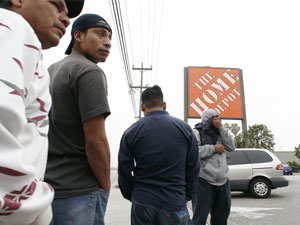
Senate Begins Debate and Key Stakeholder: Illegal Immigrants


The infrastructure package is now in the Senate, after a break for the weekend and to discuss the Holder nomination. The Senate version is near $900B, compared to the $819B in the House package. Republican Senators are again touting plans to put money in people's pockets, but it as of yet remains unclear whether or not they can unify their ranks against the bill. These Senators, as well as a handful of conservative Democrats, have proposed a bevy of amendments, including doubling aid to people who are facing foreclosure, getting rid of many "non-stimulus related measures" (even if they could potentially create jobs) and capping all stimulus spending at $900B. And in a late-breaking (meaning a few minutes before I posted), Associated Press briefing, Mitch McConnell and other Senate Republicans blocked an amendment by our own Dianne Feinstein to add an additional $25 billion in badly-needed infrastructure money, including an additional $2 billion for desperately-needed mass transit projects, citing concerns that the bill contains too much money already. However, an LA Times article states that Republican Congressmen, particularly those from states that Obama carried, are being forced by constituents to defend their vote against the stimulus bill.

Let’s talk about the effect of the infrastructure bill on illegal immigration, an issue that has hotly been debated.


Many states with large populations of illegal immigrants are also the states hit hardest by the economic crisis. These states are also “too big to fail”, despite having measures such as balanced-budget amendments and majorities required to pass budgets that are almost as bad as the Articles of Confederation. Their governors, both Republican and Democratic, are urging speedy passage of the infrastructure bill. According to a Los Angeles Times article, part of the House package includes a measure that would require all workers receiving jobs under the stimulus package to register with eVerify, a citizenship authenticating website. Critics say that not only does it violate immigrant rights, it could slow relief in the form of infrastructure money. No doubt that this measure was driven in part by the wave of nativism that inevitably follows a downturn in the economy.

In other news, Michael Steele appointed RNC chair in attempt to relate to minorities, who have been further alienated by the aforementioned measure.

So how will we resolve the issue of immigration (which the Republicans so kindly brought up), an issue that is pulling many state governments into the red? By cutting them out of the construction industry, which often employs large numbers of them? Sending them back or not letting them in in the first place are out of the question. So we must do something to give immigrants the tools to achieve the American dream, so that their descendants can be musicians or realtors or MBA trainers or whatever. And that’s my take on immigration, the infrastructure package, and the economy. Keep the paintballs coming.


What’s Really in the Stimulus Package (NPR)

Senate Takes on Stimulus (LA Times)

An Op-Ed about the stimulus (LA Times)


More on the Stimulus Package (LA Times)